Dark Verion
  • Dark Mode
  • Light Mode

A proven path forward

ABA therapy has been helping children with autism reach their full potential for over a century, backed by more research than nearly any other autism treatment approach. The proof isn't just in the data — it's in the successful adults and children who credit ABA with giving them the foundation they needed. Your child can get there too.

Effective treatment starts
with the right assessment

Observing your child

Our BCBA conducts a comprehensive behavioral assessment, observing how your child communicates, interacts, and responds. This gives our clinical team a clear, objective picture of their current skills and abilities.

Building the treatment plan

Assessment findings and family input combine into an individualized treatment plan. The plan outlines long-term goals to establish the destination, and details the short-term steps that get your child there.

Understanding your family

We work on sustained attention, completing assignments, and asking for help appropriately during lessons.

Insurance authorization, managed for you.

Coverage Management

We verify your coverage, confirm benefits, and handle communication with your insurance provider. Once you start, we monitor for coverage changes and manage reauthorizations so your benefits don't get interrupted.

Established Partnership

Our relationships with Medicaid and major insurance providers streamline the authorization process. We understand the nuances of each requirement and guide you through each step so coverage is secured efficiently.

From session to independence:
How skills are built

Effective ABA follows evidence-based methodology — skills are broken down, taught systematically, and transferred to real life. This is how your child graduates from learning in therapy to being truly independent.

01
Breaking skills into steps

We break down complex skills into smaller pieces your child can actually learn. One step at a time, building confidence with each success before moving to the next.

From teaching to mastery

Skills are taught with positive reinforcement and practiced until your child has them down pat. We track progress with data from every session to know what's working.

02
03
Generalizing skills
What's learned in therapy gets practiced at home, at school, and in the community, so your child is able to use the skills they’ve gained in all kinds of situations.

Parent sessions

Therapy is a few hours a week. You're there for the rest. Parent training bridges the gap so you’ll be empowered with clear cut methods that work for your child.

Understanding your child’s needs

Responding to challenging behavior

Reinforcing your child’s progress from therapy

Bright Peak
ABA
Bright Peak
ABA
Bright Peak
ABA
Bright Peak
ABA
Bright Peak
ABA
Bright Peak
ABA

The techniques behind the therapy

ABA isn’t one single method. It’s a set of proven techniques, each chosen based on what your child needs to learn and how they learn best. Here are some of the techniques we may use to help your child:

Discrete Trial Training (DTT)
The therapist sits with your child, presents a clear instruction ("touch the cup"), and rewards them immediately when they get it right — then repeats it until it sticks.
Used for building foundational skills like following directions, identifying objects, and early language.
Natural Environment Teaching (NET)
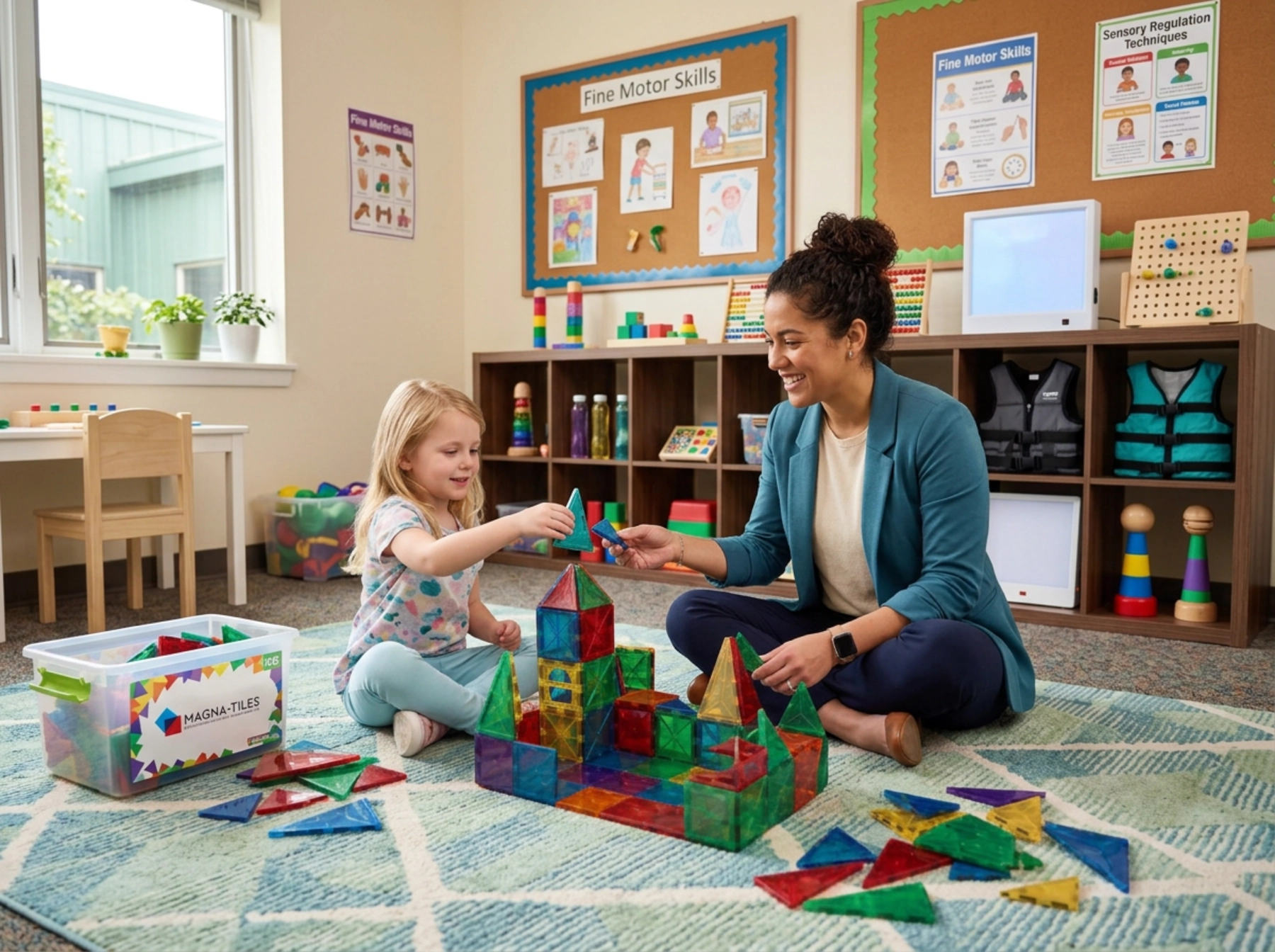
The therapist follows your child's lead during play and weaves learning into whatever they're already doing — blowing bubbles, building blocks, looking at books.
Used for teaching your child to ask for what they want, interact with others, and use skills in real life, not just during sessions.
Functional Communication Training (FCT)
The therapist identifies what a behavior (like hitting or screaming) is communicating, then teaches your child a replacement — a word, a sign, a picture card — that gets them the same result.
Used for reducing meltdowns and aggression by giving your child a way to express frustration, pain, or a need without hurting themselves or others.
Pivotal Response Treatment (PRT)
The therapist lets your child pick the activity, then builds learning opportunities into it — if your child loves trains, trains become the vehicle for every target skill.
Used for building language and social skills in children who shut down with structured drills but thrive when therapy feels like play.
Verbal Behavior Therapy (VBT)
The therapist teaches language as a tool rather than just words — your child learns to ask for things, answer questions, and describe what they see as separate, practiced skills.
Used for developing functional communication in children with limited or no verbal language, including learning to use an AAC device.
Token Economy
The therapist gives your child a token each time they complete a target behavior, and after earning a set number they trade them in for something they love.
Used for helping a child follow a routine independently, stay on task, and move between activities without melting down.
Social Skills Training
The therapist breaks down a social situation — joining a game, initiating a conversation, taking turns in conversation — and practices it with your child in a structured, low-pressure setting.
Used for building friendships, navigating classroom situations, and reducing the anxiety your child feels when social interactions feel unpredictable.

Decades of research. Thousands of children who've gained the skills to thrive.

With Bright Peak ABA, your child can have that too.

Bright Peak ABA delivers proven, research-backed ABA therapy for children with autism in Iowa and Maryland.
Copyright © 2026 Bright Peak ABA. All rights reserved.